
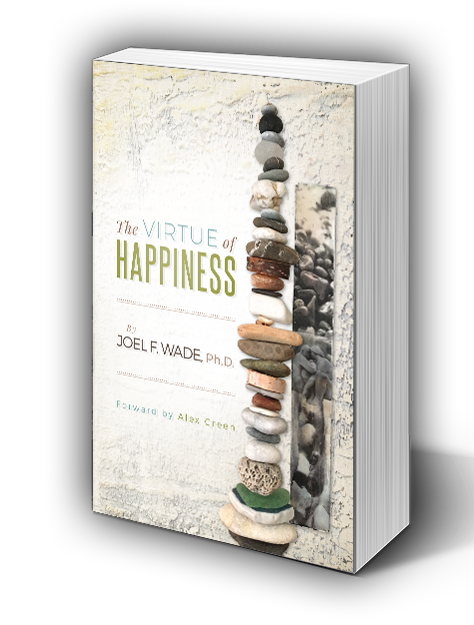
(This is from the introduction to my book, “The Virtue of Happiness”)
Happiness is not a smiley face, and a happy life is not a perfect Facebook profile of blissful moments and beaming selfies building on a continual upward trajectory.
We are biological, not mechanical; our minds are not computers – though some functions of our brains are similar. Our lives are full of rhythms, cycles of expansion and contraction, ebb and flow. Just as a tree will withdraw into itself beginning in the Fall and during the winter, dropping its leaves and growing its roots, then expands out with new buds, blossoms, and fruit in the Spring and summer, our bodies pulse with heartbeats, breaths, and cycles of sleep and wakefulness. We don’t remain in a continual state; and we cannot expect continual, uninterrupted happiness or success.
Our consciousness is organized around stories; including our own personal stories of tragedy and triumph, comedy and creativity, love and loss. We have some say in the nature of the stories with which we identify – to what degree we see ourselves as authors of our stories; to what degree the characters can learn and grow; what possibilities there may be for interesting plot twists – and this is one of the ways we can steer ourselves toward a better life, a better sense of ourselves: We can think of our lives within the context of a better story.
We are constrained by the probabilities of life – our personal genetics, our inborn temperament, the nature of our birth and upbringing, the burden of our weaknesses and the blessings of our strengths. We are liberated by our imaginations, our courage, our consciousness, and our ambition, to defy our personal probabilities – to overcome hardship, to recover from setbacks, to master our diagnoses, to move from addiction to sobriety, to channel the best within us to create something better than we might have expected.
Life itself is a defiance of the principle of entropy – the tendency for matter to devolve into chaos and disorder. Life takes nutrients and the energy of inspiration and creates its own order, its own structure, and its own direction. As human beings, our consciousness allows us to take this process a step further, expanding it into a different dimension: To decide consciously to move in a particular direction; to create, to engage, to love.
So a human life that is happy is not a trivial matter of being lucky, of getting what we want; of pleasant pastimes or the absence of responsibilities or pain. A human life that is happy is an accomplishment; a triumphant, sometimes even a heroic creation. Some of the most deeply and genuinely happy people I’ve known have overcome tremendous physical or psychological hardships to get there. As with any big, long term project, it takes work; it’s complicated and time consuming – more like a great symphony of harmony and counterpoint than a simple catchy jingle. To create a life that is truly happy over time takes discipline, passion, and courage.
A happy moment can be a matter of luck; a happy life requires virtue.
Virtues are character strengths. In the same way that being strong and fit in our bodies allows us to perform well, to be of use, and to flourish in the world of physical activity, virtues allow us to perform well, work together with others, and flourish in our psychological and emotional lives. Our genes, our environment, and our upbringing – the good people and circumstances we’re blessed with – are what we are given in this life; our character is what we do with it.
Authentic, long term happiness is a virtue because to aim toward authentic happiness is to aim for the best within us; it gives us a feedback system that can guide us toward a life well lived. A happy life requires virtue; and the interplay between our virtues, and our striving for happiness, creates a virtuous cycle.
The virtue of self-discipline or willpower is essential to a strong, effective character. Without self-discipline, we cannot create, we cannot deliberately make good things happen, we cannot be reliably good to the people in our lives. Willpower is the most important strength – and its lack is the biggest limitation – for happiness and success. Our consciousness and willpower allows us to decide what kind of person we want to be, and then to aim ourselves there.
Without the virtue of courage, we stand helpless in the face of fear. Fear is a wonderfully powerful motivator. It can prevent us from doing really stupid, dangerous things; but it can also keep us from trying new things, going against the status quo, challenging dogmas, or standing up against bullying and injustice. Courage is what allows us to feel afraid, and do what we need to do anyway. C.S. Lewis said, “Courage is not simply one of the virtues, but the form of every virtue at the testing point.” It is courage that allows us to do the other virtues when we are afraid to do so.
Without the virtue of compassion, we become self-absorbed and isolated, wondering what’s wrong with all those other people over there who do not think or feel or act like us. Compassion is what allows us to see others as fellow human beings, and not as things that exist to do our bidding. The late Chris Peterson, one of the founders of the field of Positive Psychology, was asked to sum up his understanding of happiness in a sentence. His answer: “Other people matter.” Compassion is what makes other people matter to us; and it is our relationships to those other people above all else that bring us the most profound happiness in life.
Why nurture our virtues? Simply to have discipline? To have courage? To be compassionate? These are all good things in themselves, but we do them because we care about what kind of person we are; we do them because we choose to aim toward what is good; we do them because it helps to bring out the good in others – and for their goodness to bring out the good in us; we do them because we want our own lives to be worth living. We practice them in the service of a deep and meaningful sense of happiness.
 One of the – sometimes unspoken – expectations when we buy something is that it will, to some degree, make us happy.
Recent Comments